Deviant Archaeologists: Public Representations of Archaeologist Identities and Their Harmful Effects on ‘Fighting’ Illicit Traffic
This post (the abstract below and the text that follows) are part of a talk I gave at the American Society of Criminology conference in Washington D.C. in November 2015. Please keep the date in mind while reading. The theme for that conference was The Politics of Crime and Justice, and I thought it would be a good fit for some the stuff I had been working on at that time. I ended up designing and co-organising a thematic panel for the conference, titled: ‘The Illicit Antiquities Trade: Organisations, Facilitators, and Policies of Practice in Transnational Spaces’. Of course, as seasoned academics are aware, the theme of a panel means very little at the end of the day as most presenters just kind of do their own thing and frequently go completely off topic. I tried, however, to stay as close as I could to the theme of our panel session, having in mind the idea of archaeologists as facilitators of transnational criminal activity, and their own actions – or total lack thereof – as long-standing practice within this framework. There were only a handful of people in attendance, the majority of which were people from the University of Glasgow (my former affiliation) and a few others from different institutions. One man in particular (an archaeologist, I think) boldly walked out half-way through my presentation after looking befuddled and disagreeable – something I found interesting, later realizing that it was likely because everything I was saying was on the right track.
Here is that presentation.
ABSTRACT
Archaeologists are often lauded as ‘guardians of the past’ and ‘stewards of history’ and are assumed to care deeply about the preservation of mankind’s cultural heritage. This paper reconsiders these normative assumptions by examining the idea and image of the ‘caring archaeologist-self’ as a deliberately constructed social identity that is reinforced in the public domain and communicated through a variety of media. This paper argues that the accuracy and authenticity of this public image should be questioned for several reasons, and that the perpetuation of such representations has harmful effects on the actual ‘fight’ against illicit trafficking in the transnational antiquities market. The paper concludes that because of the harmful effects caused by these oft-celebrated inaccuracies, misrepresentations, and other deviant conduct, global cultural heritage preservation efforts will continue to be problematic and the illicit trade will persist until archaeologists get real with themselves (and the public) about their role in this problem.
Introduction
“Words are meaningless outside of a language structure, and scientific concepts only have vitality within a theory combining logic and evidence. That theory is lodged within an historical period and societal conditions that feed its plausibility.” Sumner, C. (2012:165). My emphasis.
Definitions. I will explain my logic and the evidence I have to back up my claims over the course of this presentation. I’ve highlighted this text in blue because while I think theories and lofty concepts are useful and obviously necessary for social science research, the temporal contexts they generate within add a certain weakness to their saliency and usefulness so I’m going with a very general definition for the purposes of this talk today.
For the record, this is a definition of deviance according to the Oxford English Dictionary (2015):
‘The fact or state of diverging from usual or accepted standards, especially in social or sexual behaviour.’ (Oxford English Dictionary 2015).
And here is the definition of image:
‘The general impression that a person, organisation, or product presents to the public: ‘She strives to project an image of youth’’. (Oxford English Dictionary 2015) My emphasis.
(i.e. images don’t have to be visual).
You are going to hear me say the word ‘image’ a lot so I wanted to clarify what exactly I mean by that so there’s no confusion as to what I’m referring to. There is a sort of abstraction to this conception of the word, in that it includes both visual images but also emotional and mental impressions that are projected outward into the public domain. But when I reference the image that archaeologists present, what I’m getting at are the non-visual representations.

Image 1: Jessica Dietzler (2015)
I am going to talk about authorized archaeologists (academic and professional) and their role in the facilitation and therefore perpetuation of the transnational market in illicit cultural goods. This chart (above) is meant to show heuristically the way I conceptualize ‘archaeologists’ as a community made up of at least these three sub-groups (which you can see here all in blue). The differentiation between authorized and unauthorized boils down to power and control over discourse. Because Academic and Professional archaeologists’ discourse is considered ‘legitimate’ – or normal – by the establishment and is accepted as such by other governance stakeholders, they are therefore considered authorized. NB: I’m not the one who came up with this idea of authorized versus unauthorized with reference to archaeologists – that was done by someone else and I can’t remember their name at the moment but can find it for you if you want it. Get at me after the talk or send me an email.
The role of the academy in the facilitation of the market has been considered and explored, particularly by Brodie (2011) and has included both archaeologists and art historians and others; but I’m zeroing in on archaeologists in particular because A) I have a background in the field myself (that is, I’ve studied it for fifteen years in University and practiced it in a variety of capacities in the field and in the lab for over a decade, with the exception of the last five years because I was doing a PhD; and B) because archaeologists are rarely examined critically as they are often assumed to be busy doing very important work on behalf of cultural institutions such as museums and Universities, and because most people’s mental image of them is one that is relatively innocuous and far from any meaningful associations with crime – especially crime that is transnational, serious, and organized. In fact, in this field of antiquities crime scholarship, archaeologists have long been the ones to whom outsiders have looked for contributions to public debate and suggestions for solutions to global policy problems regarding the traffic of illicit antiquities. Policy-makers and other institutions prize the perspective and input from authorized archaeologists because they are assumed to be caring ‘guardians of the past’, magnanimously stewarding the remains of human history for the rest of the world to consume without thinking too much about the processes of production of those histories and narratives. This view can be summed up by saying that archaeologists are assumed to have the best interests of global society at large in mind when they are conducting their investigations, and their work is meant to enlighten the entirety of humanity. However, I will show here, that these general assumptions about the benevolence and helpfulness of archaeologists in the antiquities trafficking debate are misguided, and in fact contribute to the overall international trafficking problem for reasons that may not be immediately or visibly apparent on the surface of things.
First, I will outline the idea of the ‘caring archaeologist self’ and discuss how this sort of image (or depiction) of archaeologists is a discursive frame (or one reality) that conceals another reality entirely (that is their true concern) with regard to the transnational illicit antiquities trade. Then I will discuss the accuracy of that image – that is, whether that image is an accurate or inaccurate depiction – and consider what archaeologists stand to gain by crafting and projecting such an image. Afterward, I will discuss the harms that these uncontested depictions have on the field itself and on the fight against the illicit traffic in cultural goods.
Archaeologists are sometimes said to be ‘guardians of the past’ and ‘stewards of history’. These terms imply a certain quality of valor, responsibility, and care (care being the most important) for the tangible and intangible things of the past. While archaeologists do not – to my knowledge – refer to themselves reflexively this way, they do seem to be quite comfortable embracing and shouldering the burden of these epithets (and by ‘burden’, I mean the responsibility that the terms imply). But how accurate are these ideas of archaeologists when we consider them within the framework of the transnational market in illicit archaeological objects? In lieu of an absence of first-hand interview data from archaeologists themselves, there are a few things that can supplement the information we already have. Looking to social media, we can find several examples of the sort of image that archaeologists wish to project out into the world.
Certainly the creation of an image that represents all archaeologists does not fall into the hands of only one or two people, institutions, or organizations. The image of the caring archaeologist-self that is often projected out into the world is evident in the facades of sector-relevant NGOs that are largely led behind the scenes by communities of academic archaeologists and professional experts loosely tied to academic archaeology through the fields of art history, anthropology, law, etc. Here are a few screenshots showing examples of the image that is often projected:

WE CARE: OUR PAST IS IMPORTANT
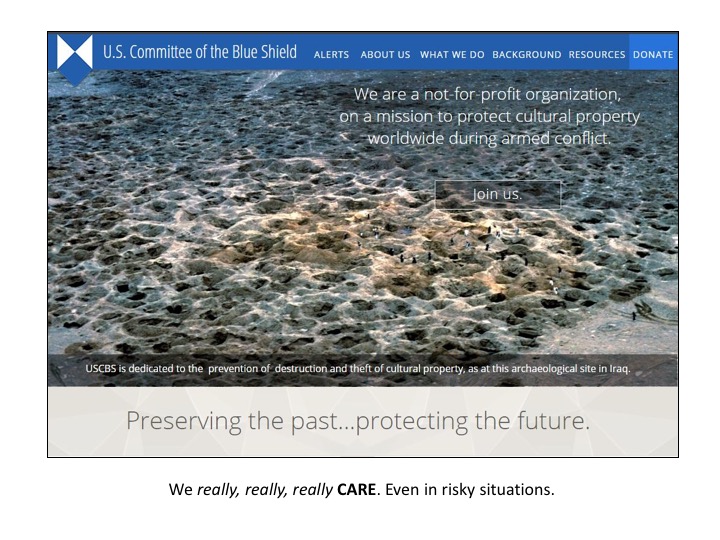
WE CARE: WE MITIGATE RISK POSED TO FUTURE THINGS BY PRESERVING HERITAGE NOW
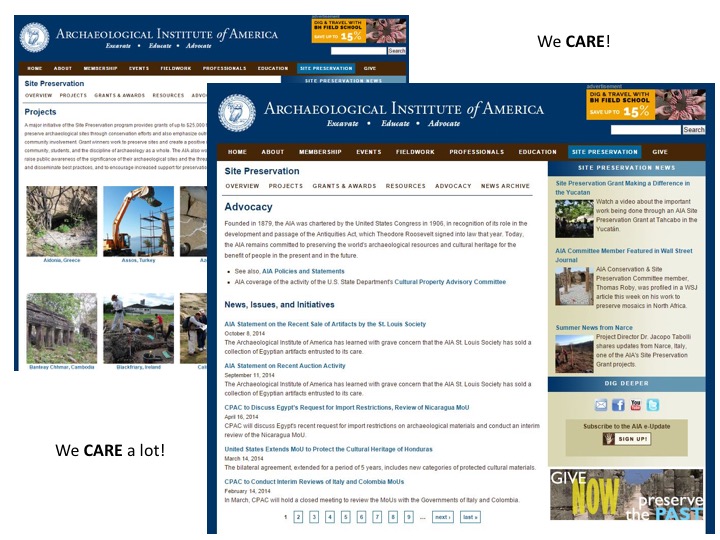
WE CARE: WE PRESERVE SITES; WE ADVOCATE and INSTITUTE OTHER IMPORTANT INITIATIVES

WE CARE: WE ARE SOLEMN and WE EXPRESS OUR AFFECT about the loss of cultural heritage – JOIN US IN SOLIDARITY
The message that archaeologists CARE is projected very clearly and the use of social media as a tool in shaping this image is paramount to upholding its existence as a ‘fact’.
Accuracy of the image
So how close to reality is this representation of the caring archaeologist-self? (different realities or different degrees of the same reality?) Does the projected image fit all archaeologists? Are the archaeologists that live up to this image the rarity or the norm? The AIA, commonly regarded as one of the largest, most relevant and legitimate institutions affiliated with academic archaeology – delivered a public statement regarding the issue of open access journals – a statement delivered by the President of the AIA on behalf of the organization and everyone affiliated with it – that the AIA and the archaeologist members therein do not and will not participate in open access publication of archaeology-related things. This is obviously a major contradiction to the ‘care’ I’ve been referencing throughout this talk because without open access to their work, the public remains relegated to the sidelines of knowledge about the past, about archaeological sites, about the latest finds, about theories, criticisms, the looting problem, et cetera. Now let’s think back to the slide we just saw that declared that KNOWLEDGE ABOUT THE PAST IS A HUMAN RIGHT. If archaeologists actually care about the past and think that knowledge about cultural heritage is a human right, one would think they would be less insular, more forward thinking and inclusive in making their work more publicly accessible. Truth be told, the President of the AIA came under heavy fire for making this statement about open access and eventually released an addendum under pressure (see below).

Screenshots of AIA webpages
So the question remains: Do Archaeologists Actually Care? In my experience, a lot of them say that they do, but rarely (actually) do anything about the looting problem in any capacity. Some do (e.g., Neil Brodie, Morag Kersel, Lord Renfrew, et al.), but these individuals seem to be the exception rather than the rule. My fieldwork shows that archaeologists may not actually care that much despite the popular assumption that they do by virtue of the nature of their work. In the absence of primary data from archaeologists themselves, I wondered if it was possible to get any sort of measure of concern or ‘care’ – about the trafficking problem – that archaeologists may or may not have by asking participants about their relationships with archaeologists, and (for this 2015 ASC presentation) doing cursory google searches for relevant connections between archaeologists and the illicit antiquities trade using certain keywords. Here I will detail what I did and what I found. It’s important to weigh operational knowledge against social media projections and observational opinion in order to arrive at a more realistic understanding of whether or not archaeologists actually do care. So here we go.
Field Notes & Interviews
There are some things my fieldwork participants said that also contradict the taken for granted notion that archaeologists care about the trafficking of illicit objects and these statements are relevant because they shed light on an aspect of archaeology that is usually shrouded from the public eye: the hidden realities of apathy and facilitation which, in some instances, may speak to corruption and collusion, but most often to passive facilitation through general inaction.
Field Notes (from Country A):
CO suggested to Wayne that he arrange a meeting with the archaeology superintendents of the country for me. Wayne told him that he already tried to contact them (via phone and email) but to no avail. CO then mentioned the name of someone who works at the Superintendent’s office and suggested to Wayne that he try that person, and call and email everyone else again. Wayne sighed and said “Ok.”
After my interview with Wayne he became quiet and brought his voice to a near whisper, looked behind me suspiciously at the door (as if to check that no one would hear what he was about to say), stared at me and said:
Wayne: You know… it’s a bit strange, the Superintendents. I know I told you that I contacted them for you and the CO told me to do it again but… he knows… it’s a bit strange because for some reason they rarely respond to us.
Me: Oh really?
Wayne: Yeah. They are really difficult to reach. I send email after email, phone calls all the time, but I never hear anything back from them.
Me: Huh. That’s interesting. I wonder why? Is it always this way?
Wayne: Yeah. I don’t know why. It is just really difficult to get them to work with us.
Me: Interesting.’
Wayne wasn’t a newbie as he was, at the time of our speaking, already at his high-level post in national law enforcement for over 15 years. That being said, however, he had only been dealing with cultural property crimes as a speciality for two years. But that’s still two years of trying to get the Superintendents to work with him and his office. His CO had more experience with the Superintendents and presumably knew about this issue but was advocating making an extra effort to get in contact with them while I was present as a good gesture and example of good intra-national agency cooperation. There were many of these kinds of instances throughout the entirety of my fieldwork. What is important to note about these exchanges and the relationships between law enforcement and archaeologists is that there is often an edifice of ‘good cooperation’ but in reality the cooperation isn’t there at all. In fact, there is in some cases active resistance in its place.
Interview Excerpt I (from Country B):
Here are some of the things my specialist (specially trained and high ranking) national law enforcement participants said (see below). These statements are relevant because they shed light on an aspect of archaeology that is usually shrouded from the public eye: the hidden reality of apathy and/or facilitation which, in some instances, may speak to corruption/collusion and certainly facilitation of the illicit trade.
Howard: As I told you earlier, we have half a million sites, archaeological sites in our country, and between 1992-2012, we only had 18 complaints. No more. That’s less than one a year.
Me: Regarding looting.
Howard: Looting. Yeah. So that’s… there’s a problem.
Me: Do you think they’re seeing it and they just don’t care? Or they don’t know who… (to contact in law enforcement)?
Howard: That… at that time, yes. There was: ‘I don’t care’; ‘I’m so discouraged that I don’t want to do anything’…
Me: ‘I didn’t know it was a crime’?
Howard: See, doing it… doing it, you may think that the guy doesn’t know it’s a crime. Even though here (in this country), no one is supposed to ignore the law. You’re not supposed to ignore what the law is. But think, for a moment, that the guy actually doesn’t know and he does it, right? When you’re an archaeologist, and you arrive in the morning and you see that there’s a big hole where there was no hole the day before, if you don’t do anything with the police service, that’s a problem. And that’s where the problem stood at that time.
Me: Why were the archaeologists not doing anything?
Howard: As I said before, there was a bit of ‘why is it worth doing that?’ ‘Is it really worth the pain of it all?’ and “Oh there’s something you can do? Oh, well, I didn’t know about that” and (exaggerated sigh)… What the fuck? So.
Me: It seems strange to me that these things… I mean, archaeology is a very specific thing. And these people spend their whole life learning to do this stuff and to have these projects at these sites… I worked at one project myself that has been looted many, many times. And it makes you angry because you see your work destroyed.
Howard: Yeah! But eh. I went to see them in August last year and I said “What’s the problem?” And actually they figured out that there was a problem, and I’m not talking about the stuff in the museum of archaeological stuff, that’s different stuff. But the thing is that, on the (archaeological) site, there was a problem of… I discovered there was a problem within the archaeologists. And some said “I wanted to file a complaint about that, but my boss said ‘no'”. But why did he say ‘no’? “Oh because he said he, you know, doesn’t want the…” Yeah, but, he doesn’t have to judge. He’s… it’s not his job. “Oh, there was [excuses]…” What the hell… and I said but, you have (name), the guy, is telling you that you have text and laws and articles of law saying what you can’t do and what you have to do. You can, in any case, go and file a complaint at the police office, you can write a report yourself if you’re at that level in the hierarchy, etc., you can make a report – write a report if you’re not allowed to. “Oh yeah, oh yeah, ok” and they start figuring it out… because they… we just have to talk to people and tell them to do things. Because, you know… (makes a face to indicate they should know better). It’s funny sometimes to talk to them.
Interview Excerpt II (from Country C):
Me: Do you think archaeologists could do a better job at teaching people what the difference is between doing actual archaeology and just digging a hole.
Daniel: Just…? Excuse me?
Me: Digging a hole in the ground.
Daniel: Yes.
Me: I feel like archaeologists don’t, they don’t do enough.
Daniel: They are involved, but… they are involved in their studies.
That is to say that they don’t have time; or alternatively, put more critically, that they are actually self-interested and too involved in their own academic pursuits to care about trafficking or educating people about what they do and why they should care about it.
Google Searches
Aside from social media screen shots, interviews with my participants and field notes, I also did four cursory Google searches (in 2015). Everyone uses Google. It’s pretty easy to find information on Google. You may not find accurate information but you will find information nonetheless.
- A google (UK) images search of the term ‘illicit antiquities’ returns many general images, most of which are either from the archives of the Illicit Antiquities Research Centre at Cambridge, Sam Hardy’s Conflict Antiquities blog, Paul Barford’s blog, the websites of Trafficking Culture, SAFE, Chasing Aphrodite, and ‘Day of Archaeology’. The same is true for a quick google general web search (not images) of the same term (i.e. the returns were from the websites and organizations just mentioned). Notable was the relative absence of returns for images and general information on the web from archaeological societies, specific projects, and University departments bearing statements regarding the illicit antiquities trade.
- A google image search of the terms ‘archaeologists’ + ‘looting’ returned several results – mostly satellite images of the pockmarked looting fields in Syria and Iraq and other such places; a google general web search of the same terms returned several results – the majority of which were written by journalists and bloggers, not the practitioner community of academic or professional archaeologists.
- A google general web search using the term ‘concerned archaeologists’ + ‘petition’ returned several results, most of which dated to 2012 and referenced ire at the American TV show ‘Diggers’; another petition found was titled ‘Protest against cuts in the public funding of archaeology in Germany’; there were also a few petitions to stop real estate developers from building on historic sites; etc.
- Google general web search of the words ‘archaeologists’ + ‘illicit’ + ‘antiquities’ revealed little in the way of anything written by archaeologists about looting at sites they work at, or any acknowledgement or discussion whatsoever about the illicit trade in general; in fact, most of the results were from the same organizations mentioned earlier in search #1.
Of course, some might say my keywords may be problematic in that I used perhaps the wrong ones or possibly the wrong combinations of them. Or additionally that maybe I should have used American Google rather than Google UK, or even another search engine to discover relevant links. Taking those possible weaknesses into account, there is still something to be said about the notable absence of easily accessible dialogue and relevant publications and information from a global community of literally thousands-strong so-called ‘guardians of the past’. Could it be that they aren’t aware that looting is happening or that trafficking of archaeological antiquities is a problem throughout the world? Blythe Bowman’s (2008) research shows that this is highly unlikely. In fact, most of the respondents not only knew about these issues, but actually have direct experience with them at the sites that they work at. Drawing from my personal experience over the last ten to fifteen years, I can tell you that the idea that archaeologists do not know what to do or what is happening regarding the looting and trafficking of antiquities is a misguided assumption.
Notwithstanding the experiences I’ve had in the past, I recently had two interesting experiences that echo the sentiment I am expressing today. The first is a curious rejection of the abstract from this very paper that I sent to a group of archaeologists organizing a conference last spring (2015). When I received the email rejection from them, they told me that the subject matter – what I am talking about here today – was not considered ‘relevant’ for their conference. I wasn’t exactly surprised to receive the rejection as my experiences with archaeologists in the past point to a particular resistance and borderline arrogance regarding issues of critical reflexivity in the field. So there is something to be said about this refusal and I consider this particular instance a point of data that can be drawn upon to complement the rest of my work over the last several years. The second experience is a curious silence from one of the most powerful archaeological organizations in the Western hemisphere. I sent an email to the AIA asking them for copies (pdf or otherwise) of all of their conference programmes from the last ten years so that I could scan them to tally the number of times sessions were organized around looting and illicit trafficking activities. I was told to email the director directly, which I did, but received no reply to my request whatsoever. So I sent another email, to the administrative assistant, letting him know that I never heard anything back from the director after sending a couple emails. I asked if perhaps she was on holiday. He said he’d see what he could do for me but that he didn’t think there were any copies of the programmes. It’s been months and I have yet to hear anything from him. So what is going on? And how does this coincide with the idea of the caring archaeologist self?
The practice of authorized archaeology (academic and professional archaeology) has come under critical scrutiny many times in the last twenty to thirty years. It is now widely acknowledged by critical heritage scholars that authorized archaeology has serious ethical and control issues that remain to be dealt with – either within or without the practitioner community of archaeologists – and is in reality a practice that is largely postcolonial in character (with very few exceptions particularly in the Classical school). Focusing on ‘archaeology’s legacy of scientific colonialism’, Nicholas and Hollowell (2007:59) have poignantly noted:
“While most archaeologists are nominally in favour of a more equitable archaeology, in reality they still hold the power in terms of the actual production and interpretation of actual archaeological knowledge, access to or use of data, and the capital derived from these processes. The very idea of sharing power appears threatening to some because it means a radical re-visioning of ethical responsibilities and research paradigms and altering deep-seated notions about scholarly privilege, intellectual property, and control over the production of knowledge (Ames 2003:171; Conkey 2005; Joyce 2002; Meskell and Pels 2005; Nicholas and Bannister 2004; Harding 1998).” My emphasis.
In truth, ‘archaeology is a violent form of disaster capitalism par excellence’ as Hutchings and La Salle (2015:16) would have it, and in this way also serves the State and its politically potent narratives to a great extent (ibid). This idea of the entanglement of archaeology with neoliberal mentalities and capitalist motives that play into dominant state narratives and rationalities is not new, nor am I the first person to draw attention to it (see Kersel; unfortunately the citation is lost to time and lack of library access. My apologies – JD 2022).
The plurality of settings in transnational spaces can and do obviously affect the contexts around and within which archaeologists act in the world and its probably impossible to measure all the different ways and reasons archaeologists do and do not care about the looting and trafficking problem. But to be sure, based on what I know from personal experience in the field and what I have showed you today, it isn’t really a stretch to say that archaeologists do care about looting and antiquities trafficking – but – that their care is actually self-focused as opposed to outwardly focused or community focused. I argue that the ‘caring archaeologist-self’ – this image that is so often projected out into the world – is a social construct that is largely façade, mostly due to the fact that being vocal about these issues surrounding the international market is not in the best interest of archaeologists because it is not in-line with their hidden capitalist motivations. What are their hidden capitalist motivations? Their careers; making money; securing peer reviewed publications (the more you have, the better you look on your CV, the more attractive you look in job interviews, the closer you get to tenure track positions or climbing higher than whatever rung of the institutional ladder you’re on); maintaining site permits and permissions (which are time intensive and notoriously fraught with difficulties); upholding (and sometimes faking) the legitimacy of their site context and therefore the legitimacy of their studies (without stable context you have nothing; in fact, without stable context you are literally just digging holes); without stable context, empiricism goes out the window – and publications are based on pure speculation and are in reality no better than any of the antiquarian travel journals from the 18th or 19th Centuries.
Though not necessarily criminal behavior, the borderline arrogance, the refusal to be and/or promote honest reflexivity in the field, and the active resistance to working with law enforcement regarding these issues does constitute deviance to be sure. If all the normative assumptions indicate that archaeologists actually give a crap about these issues and consider protection of the past a universal concern, and those normative assumptions break down under critical scrutiny and show archaeologists to be self-interested and quite anti-universal, then this behavior can certainly be considered deviant. The harms are the same as they’ve always been: the most important of which being the communities shouldering the economic burden of lost assets.
Conclusion
So what? Do archaeologists actually care about the trafficking of antiquities? Yes and no. There are, to be fair, those who care more than others. But overall, if there are many archaeologists who do care, they certainly do not show it in reality. The idea of the caring archaeologist self is not what it seems on the surface (i.e. they do care, very much, but mostly about themselves). The apparent truth is that being vocal and reflexive is not in their best interests. To be vocal, more active, and reflexive would clash with their hidden capitalist motivations. These hidden motivations and lack of action constitute deviant behavior, and because of their social and institutional privilege, the resulting harms are harms of the powerful. Where then do we go from here? If there is any salvation for archaeologists going forward, it will be in increased critical reflexivity as an enlightened collective that recognizes how its power and activity – or utter lack thereof – affects the world. Archaeologists need to get real with themselves first about their shortcomings, about their privilege, then put some real action behind their words and projected images. Another option that would go a long way to affecting things would be to implement policies of accountability in academic departments and perhaps even in international legislation. Archaeologists escape the negative spotlight largely because of their institutional, racial (mostly white), and social privilege. Holding them to account and imposing professional penalties for inaction would certainly affect not only their careers but also how often law enforcement hears about looting activities, and how well we can inevitably understand and treat the international archaeological antiquities trafficking problem.
References:
Hutchings, R. and La Salle, M. (2015) Archaeology As Disaster Capitalism. In International Journals of Historic Archaeology.
Nicholas, G. and Hollowell, J. (2007) Ethical Challenges to a Postcolonial Archaeology: The Legacy of Scientific Colonialism. In Y. Hamilakis and P. Duke (Eds.) Archaeology and Capitalism: From Ethics to Politics. Walnut Creek, CA: Left Coast Press.
Sumner, C. (2012) Censure, Culture and Political Economy: Beyond the Death of Deviance Debate. In S. Hall and S. Winlow New Directions in Criminological Theory. London: Routledge.
Young, J. (1992) Deviance. In P. Worsely (Ed.) The New Introducing Sociology. London: Penguin.
 Spirits of Governance